

The Unseen Vulnerability: Why Basic Health Insurance Isn't Enough to Protect Your Income in Singapore
Ask most working adults in Singapore if they are covered for medical emergencies, and you’ll usually get a confident response: "Yes, I have MediShield Life and an Integrated Shield Plan rider!"
While Singapore boasts one of the most efficient healthcare systems in the world, there is a dangerous misconception that hospital insurance solves every financial problem caused by a medical crisis.
Here is the cold reality: Hospital insurance pays the doctor and the hospital. It does NOT pay your rent, your groceries, your kids' tuition, or your monthly mortgage.
If a serious health setback forces you to take six months or a year off work to recover, medical insurance will settle your hospital bill. But who replaces the salary that pays for your daily life?
At TallRock Capital, we help everyday working professionals and families spot these hidden coverage gaps so an unexpected health event never threatens your financial independence.
Understanding Singapore's Healthcare Safety Net
To protect your family's income, you first need to understand what Singapore’s national schemes actually cover—and where their boundaries end.
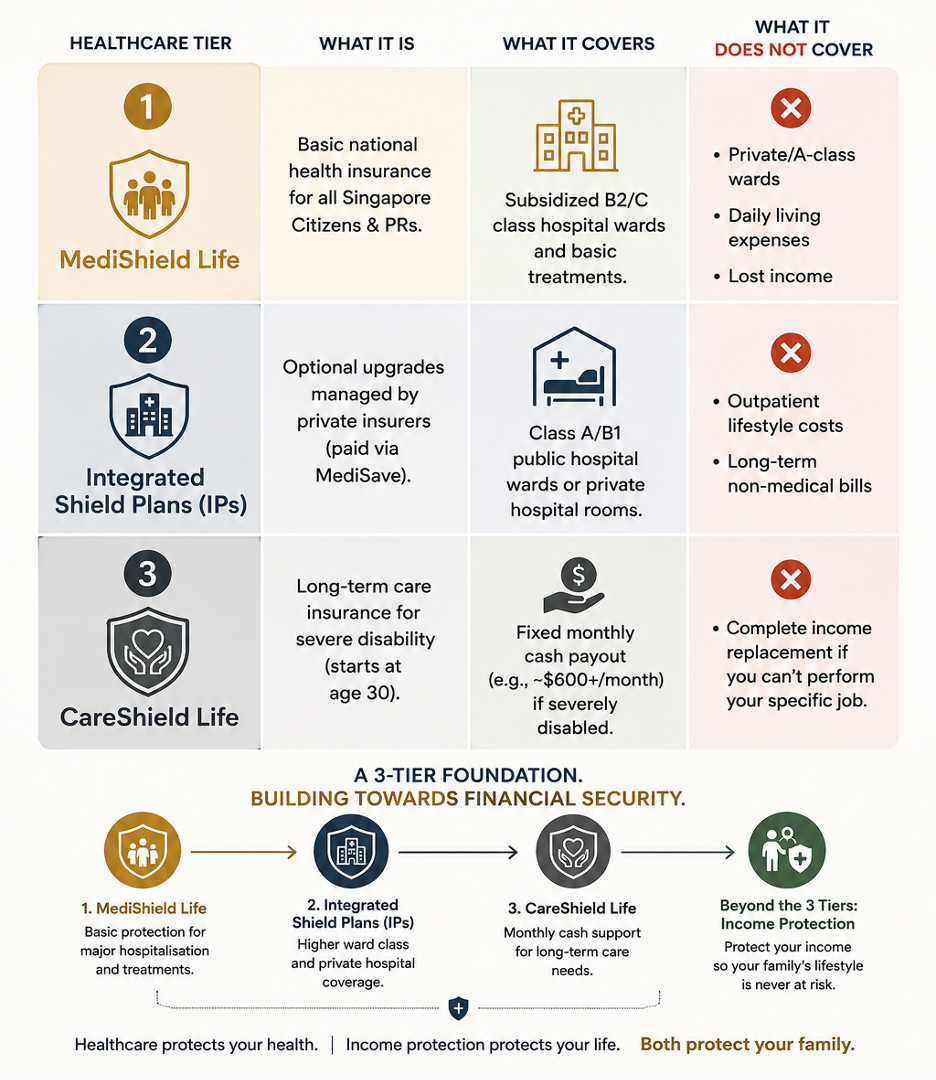
The gap is clear: national healthcare schemes are designed to prevent catastrophic medical debt, not to replace your monthly paycheck while you recover at home.
The 3 "What-If" Gaps Most People Overlook
When evaluating your family's safety net, look past the hospital discharge bill and consider these three major operational risks:
1. The Outpatient Recovery Gap
Modern medical treatments—like cancer therapies, targeted biological drugs, or specialized physiotherapy—are increasingly delivered on an outpatient basis. Standard hospital insurance primarily triggers upon hospital admission. If a treatment requires months of outpatient visits without overnight hospital stays, out-of-pocket costs can climb rapidly.
2. The Critical Illness Income Gap
If you are diagnosed with a major condition, you may need 12 to 36 months away from work to focus entirely on rehabilitation. During this period, your household expenses don't pause. A proper Critical Illness (CI) policy acts as an income replacement engine, delivering a lump-sum cash payout directly to your bank account to keep your family afloat.
3. The Disability & Occupation Gap
CareShield Life provides a crucial baseline payout if an individual cannot perform at least 3 out of 6 Activities of Daily Living (ADLs). However, for a working professional, a disability that prevents you from performing your specific occupation (like a surgeon losing hand mobility or a lawyer suffering severe vocal damage) might not meet the strict 3-ADL criteria. Supplementary disability protection ensures your standard of living remains intact.
The "Income Protection Checklist" for Singapore Households
To ensure your financial roadmap is completely stress-free, run your current coverage through this simple 3-step checklist:
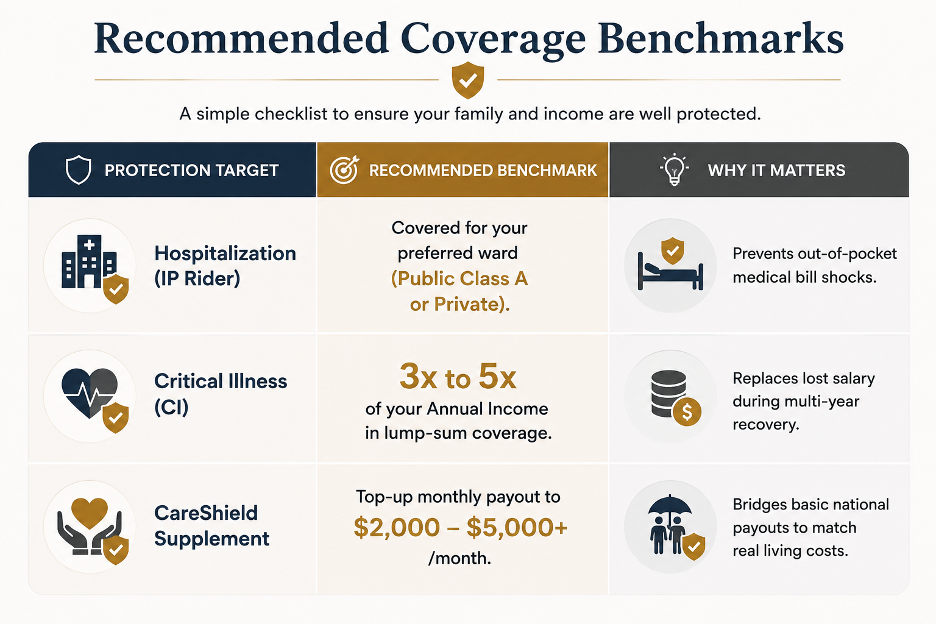
The TallRock Reality Check: Protecting the Engine That Builds Your Wealth
At TallRock Capital, we always remind our clients: your most valuable asset isn't your property, your stocks, or your bank account—it's your ability to earn an income.
If the income engine stops, even the best investment strategy comes to a halt. Taking a short time to review your health and income protection isn't about worrying over worst-case scenarios; it's about giving yourself total peace of mind. When your income is insulated, you can invest, plan, and live with absolute confidence.
Disclaimer: This article is for educational and thought-leadership purposes only. Insurance needs vary widely based on age, health history, dependents, and income. Consult a certified advisor at TallRock Capital to review your personal policy portfolio.