

From Impulse Buying to Institutional Yield: Flipped Logic for the Digital Shopping Era
In mainstream personal finance forums, the standard remedy for impulse buying is structural deprivation—budget tracking spreadsheets, deleting retail apps, or counting pennies. While these tactics are practical for entry-level wealth building, they miss the mark for high-earning executives, founders, and busy professionals.
For affluent individuals, the primary threat of a late-night checkout isn't that you'll run out of cash. The real danger is the creeping accumulation of portfolio drag and the misallocation of unmonitored liquidity.
With hyper-efficient digital ecosystems surrounding us, the friction between a passing desire and capital execution has dropped to zero. A quick midnight scroll on Lazada, an automated flash-sale alert from Shopee, a one-click purchase on Amazon, or a bulk sourcing binge on Taobao can quickly add up. At TallRock Capital, we view behavioral finance as a technical engineering challenge. By implementing a sophisticated Friction Framework, you can seamlessly flip mindless digital spending into a high-leverage, compounding investment engine.
The Anatomy of the 1-Click Leak
Modern e-commerce platforms are masterpiece designs in behavioral psychology. Features like saved credit cards, express digital tokens, algorithmic personal recommendations, and countdown timers are specifically engineered to bypass your brain's logical gatekeepers.
● The Portfolio Drag: A $1,500 premium lifestyle acquisition, an automated upgrade on a luxury gadget, or a casual $3,000 self-directed speculative trade on a mobile app feels inconsequential to a high-earning professional. However, when these friction-free transactions occur repeatedly across multiple platforms over a single quarter, they form a silent, major leak in your core investable liquidity pool.
● The Opportunity Cost: Capital trapped in depreciating lifestyle goods completely misses out on the power of compounding interest. If that same capital is captured and funneled into institutional private credit, real estate investment trusts (REITs), or global equity portfolios, it transforms from an instant expense into a high-velocity growth engine for your retirement timeline.
The 72-Hour Friction Framework
To successfully convert high-frequency impulse buying into strategic asset allocations, you must introduce intentional, programmatic friction back into your digital routine.
Instead of fighting the retail algorithms with pure willpower, implement the 72-Hour Allocation Gate:
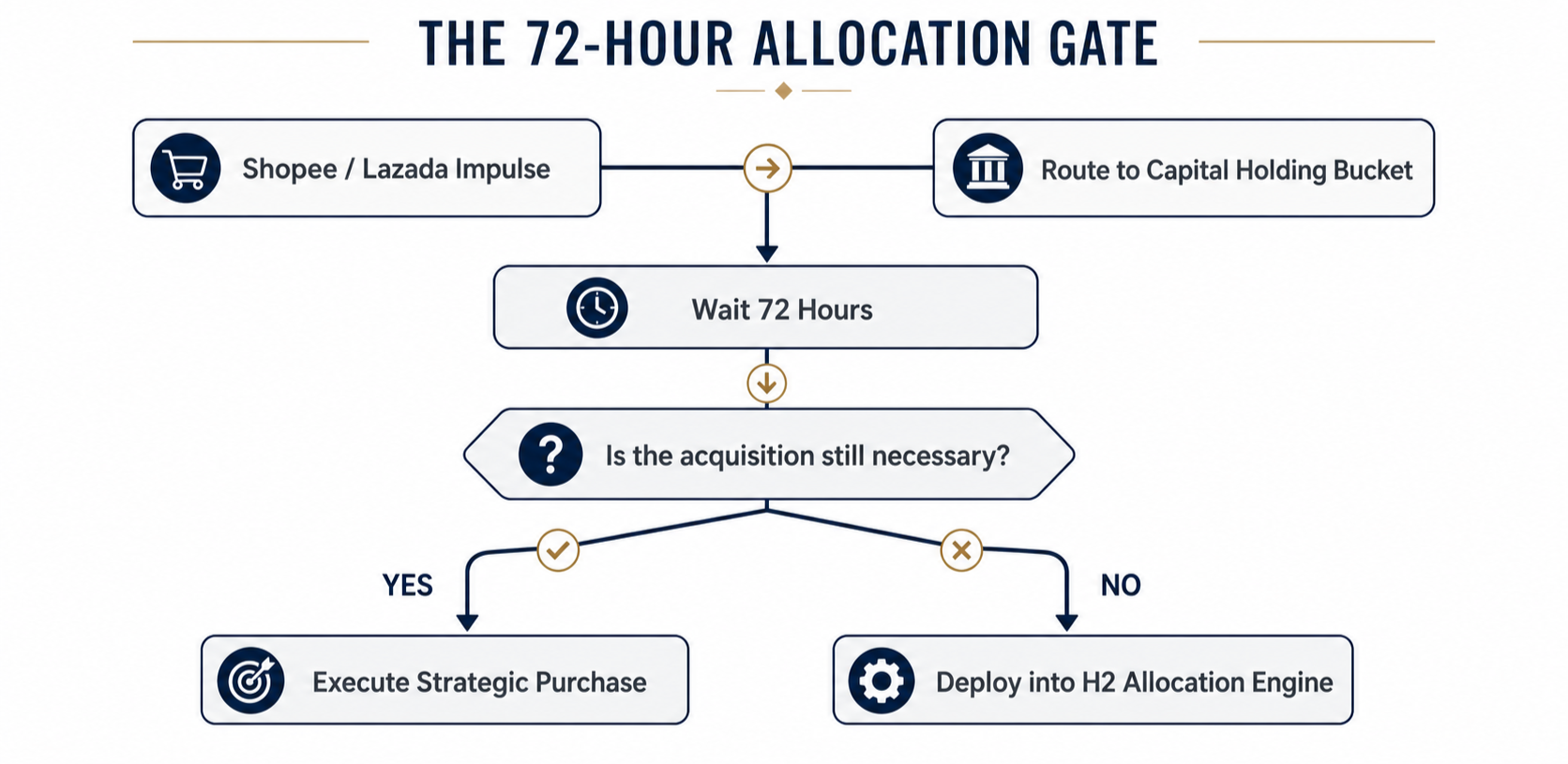
Step 1: Isolate the Capital Vector
When you find yourself on the verge of hitting "Place Order" on a high-ticket, non-essential item on Shopee, Lazada, or Amazon, stop. Do not check out. Instead, open your banking terminal and manually transfer the exact dollar value of that pending cart directly into a designated capital holding account.
Step 2: Enforce the 72-Hour Cool Down
Leave your retail cart untouched and keep the cash inside the holding bucket for exactly three days. This intentional delay decouples the emotional dopamine loop of the "instant buy" from the physical act of capital deployment, allowing your cognitive judgment to regain absolute objectivity.
Step 3: The Bifurcated Decision Matrix
Upon the conclusion of the 72-hour window, re-evaluate the cart with clinical detachment:
● The "Yes" Vector: If the asset is genuinely required to optimize your long-term operational efficiency, family well-being, or human capital preservation, complete the checkout with absolute confidence.
● The "No" Vector: If the emotional impulse has dissolved, delete the items from your cart. Leave that cash inside the holding bucket and immediately deploy it into your active H2 wealth accumulation vehicle.
Scaling Inefficiencies Into Institutional Yield
The true genius of this framework becomes clear when you audit the accumulated data over a multi-quarter timeline. What begins as a collection of minor behavioral adjustments on everyday consumer apps scales into a meaningful, self-funded investment engine.
Alt-Text: An institutional wealth graphic demonstrating the opportunity cost of digital lifestyle leakage vs. structured portfolio asset allocation.
The TallRock Insight: True Sophistication is Process-Driven
At TallRock Capital, we understand that wealth mastery is not defined by strict financial self-denial; it is achieved through superior system design. High-performance portfolios are not built on restriction—they are powered by optimized processes that capture capital inefficiencies automatically. By utilizing the 72-Hour Friction Framework, you transform a natural human behavior into an efficient liquidity filter. You don't just protect your estate from lifestyle drift; you systematically capture impulse buying patterns on global e-commerce platforms and ensure that every available dollar is working directly toward your long-term multi-generational legacy.
Disclaimer: All capital allocations and investment vehicles carry unique market, liquidity, and structural risks. Past performance is no guarantee of future returns. Consult a certified financial strategist at TallRock Capital to integrate behavioral friction frameworks with your broader asset allocation policies and cross-border profile.